Head-to-Head Comparisons & Performance Tests
Best French Press for Coffee: Anaerobic & Carbonic Tested
6th Jun•13 min read
When you buy coffee for your French press and reach for a bag labeled "just roasted," you're holding chemistry in suspension. That bag feels slightly puffy. The beans smell vivid, almost aggressively fragrant. Press them into your grinder and the aroma fills the kitchen. But brew them right now, and something feels off: muddy body, muted sweetness, a flatness that doesn't match the promise. This is the degassing story, and understanding it transforms how fresh beans behave in your cup.
Fresh-roasted coffee beans contain trapped carbon dioxide (lots of it). During roasting, intense heat triggers chemical reactions that generate large quantities of CO₂, which becomes trapped in the newly porous cellular structure of the bean. When beans leave the roaster, coffee off-gassing begins immediately. A large portion of gas escapes within the first 24-72 hours, followed by a slower, extended release that can continue for days or even weeks.
Here's the catch: this gas matters for your French press. If you brew too early, excess CO₂ repels water and causes uneven extraction. If you wait too long, the aromatic compounds that make the cup vibrant have already degraded. The sweet spot (where enough gas has escaped to allow even extraction, but enough remains to protect aroma) is where the magic happens.
For a French press specifically, that window is typically around 2 days, though it can extend to 7 days depending on roast level and how the beans were grown. For choosing beans that match your press and taste goals, see our French press roast selection guide.
Roast level controls degassing speed. Darker roasts have more fractured cell walls from higher roasting temperatures, which allows gas to escape quickly and aggressively. A dark roast can be brew-ready in just 2 days. Light roasts retain a denser internal structure, which slows gas release. If you're using a light roast, waiting closer to 5-7 days, or even pushing to the upper end of that window, gives you clearer sweetness and more vibrant aromatics.
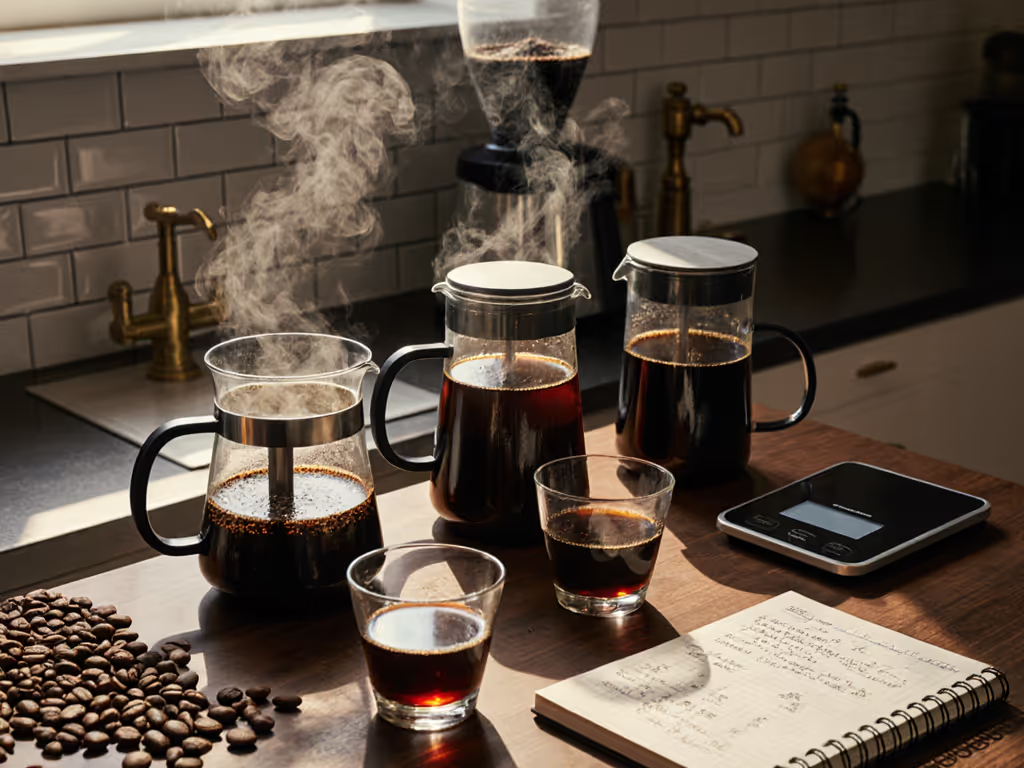
This is where guardrails help. Start small, taste big: brew a light roast at day 2, day 4, and day 7. Write down what you taste. Sour? Muddy? Clear and sweet? Those notes become your personal degassing map. Once you know your beans and your grinder, the pattern repeats.
You cannot see degassing; you taste it. Here's a structured baseline: if your French press brew tastes muddy or lacks clarity, the beans likely still have too much trapped gas, because water hasn't saturated the grounds evenly. If sweetness is fading and the cup feels hollow, you've waited too long.
Practical test: smell your beans. Immediately after roasting, they smell intense, almost piercing. As they degas, that sharpness softens into a more rounded, warm aroma. When the smell feels settled (not aggressively sharp, but still fragrant), you're often in the window.
For a French press, take a small sample at day 2, brew it, and taste for body and sweetness. Note the date. Next time you buy that roast, you'll have a baseline.
Yes, but only slightly, and there's a trade-off. A light roast needs more time to degas enough for even extraction. If you brew a light roast too early, the cup will feel thin or sour because water isn't wetting the grounds uniformly.
However, a French press uses immersion brewing, which gives you more contact time between water and grounds compared to espresso. This is your advantage. You can brew a light roast as soon as 2-3 days after roasting with good results, whereas espresso demands 1-2 weeks.
The takeaway: respect roast level, but don't mistake "fresh" for "not-ready." A well-degassed light roast in your French press is absolutely achievable at day 3 or 4, not day 14. For step-by-step parameters tailored to light roasts, follow our light roast French press guide.
Excess gas in the bean physically interferes with water absorption. CO₂ bubbles repel water, creating channels where liquid flows without fully wetting the grounds. This leads to uneven extraction: some particles dissolve quickly (bitter, sour), others barely extract (thin body, muted sweetness).
As degassing progresses, this resistance decreases. Water saturates more evenly. Extraction becomes predictable. Sweetness emerges. Aromatics dissolve into the cup instead of escaping as gas.
You don't need expensive equipment to sense this. Simply pay attention: does your French press plunge feel smooth or does it resist? Do you hear vigorous bubbling during the bloom? These are sensory signals of active degassing.
Not directly. Degassing rate depends on roast level, bean density, altitude, and processing method, not on your brewing water. However, water minerals do affect how you perceive the beans once they've degassed.
Hard water (high mineral content, typically 150+ mg/L) tends to amplify body and mute acidity. Soft water (under 50 mg/L) brightens acidity and clarity. Medium-minerality water (80-150 mg/L) often hits a balance.
If you've just bought a light roast and want maximum clarity while it's still expressing fresh aromatics, using slightly softer water (filtered or bottled) can help. To fine-tune minerals for sweetness and balance, use our water mineral balance guide. But don't chase mineral content at the expense of patience. Degas the beans first; adjust water second.
| Roast Level | Recommended Wait | Why | What to Expect |
|---|---|---|---|
| Dark (nearly black, oily) | 2-3 days | Degasses fast due to damaged cell walls | Full body, less acidity, ready quickly |
| Medium (brown, minimal oil) | 3-5 days | Moderate degassing rate | Balanced sweetness and acidity |
| Light (tan, no visible oil) | 5-7 days | Dense structure slows gas release | Brightest acidity, clearest aromatics |
I once watched someone chase the perfect press by adjusting grind, dose, and water simultaneously the moment their beans arrived, then blame the press for being inconsistent. We reset: bought the same beans, set one ratio (20 g coffee, 300 g water), one grinder setting, and waited. Day 2, we brewed and tasted. Day 4, same variables, new tasting notes. Day 6, they emerged with clarity. Within two cups of systematic tasting, their "inconsistency" dissolved into a repeatable favorite. That afternoon cemented why fresh bean extraction demands patience more than gear.
Here's the frame: when beans are young, their chemistry is changing. Your job isn't to solve that with complex tweaks. Your job is to hold everything still (same ratio, same grind, same water), and let time and beans do the work. Once you know how this roast behaves at this age, you own the variable. Next roast, you're not starting from zero.
Inconsistent flavor from cup to cup is often misdiagnosed as a grinder problem, a water problem, or a press problem. It's usually a timing problem. Fresh beans are a moving target. Respecting degassing isn't about following dogma, it's about building a baseline, tasting on purpose, and trusting your palate.
When you respect degassing:
Start with one knob, turn it slowly, taste on purpose. Buy fresh beans. Write the roast date on the bag. Brew a small sample every 2-3 days. Note what you taste. By week one, you'll have a map. By the second bag, you won't need to guess anymore.
Degassing is the foundation, but it's not the whole story. Once you're confident in your timing, you can layer in grinder calibration (matching coarseness to your specific burr type: flat vs. conical, hand vs. electric). For help matching grinders and burr types to different filter designs, use our French press grind guide. You can explore water minerals in a structured way: test your tap mineral profile, then experiment with filtered or bottled water across the same beans. You can scale your ratios for different mug sizes or team sizes with the baseline framework above.
Each of these is one variable, one experiment, one tasting note at a time. Start here. Build that rhythm. Then explore what calls to you.