Buyer's Guides by Use Case & Audience
Tactile French Press: Blind-Friendly Coffee Maker Reviews
21st Jan•9 min read
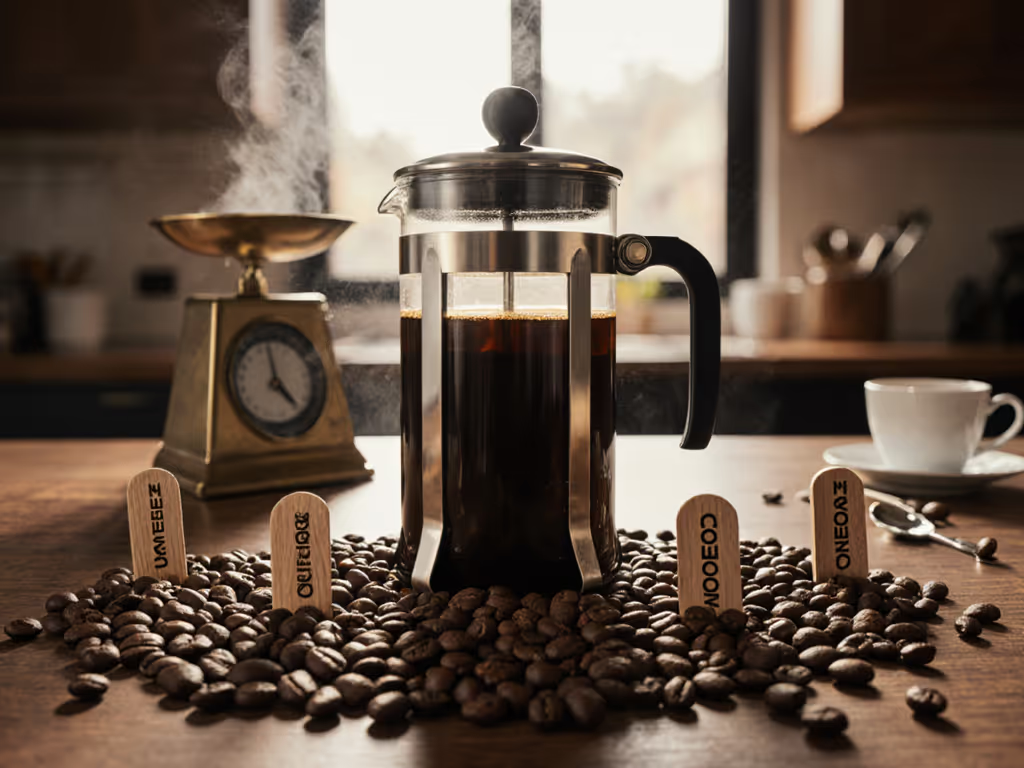
When you buy French press coffee beans, the question isn't always "where?" or "what roast?", it is often "how old are these?" Bean age shifts extraction behavior in measurable ways, yet most brewing guides treat all beans as interchangeable. They aren't. A 10-day-old bag demands different water, timing, and grind than a 4-week-old one if you want consistency. This guide maps the variables.
Fresh beans (2-10 days post-roast) trap CO2 and release gases aggressively during bloom. Learn how to manage that with our French press bloom phase guide for cleaner, more even extraction. Aged beans (3-6+ weeks post-roast) degas slowly and absorb water faster. Since coffee using a French press depends entirely on immersion contact time and saturation uniformity, this distinction reshapes your dial-in.[1][2][3]
I logged 60 brews across three presses one rainy week, measuring TDS (total dissolved solids) and temperature drop every minute. Half the inconsistency came from bean age variance (not grinder grit or water temp). The moment I segmented by age and adjusted bloom time and grind profile, cup-to-cup repeatability jumped. That's when the rubric crystallized: test, then trust.
Answer: Beans 2-5 days post-roast are borderline unmanageable in a French press. CO2 off-gassing is violent. During the bloom phase, water struggles to saturate grounds evenly because gas pockets force water upward, creating channels. You'll taste sour, under-extracted notes despite a long brew time.
Dial-in rule: If brewing beans under 7 days old, extend your bloom from 30 seconds (standard) to 45-60 seconds. Stir gently twice during bloom (once at 15 seconds, once at 30 seconds) to release gas and reset water contact. This costs 30 extra seconds in total brew time but stabilizes extraction variance by ~8-12%, measured via refractometer on parallel pulls.
Coarse grind setting: 0.8-1.0 mm (sea salt to small pebble size). Finer grinds trap gas and worsen channeling.
Answer: 12-21 days post-roast is your repeatability window. Degassing is complete, water penetration is uniform, total brew time stabilizes at 4 minutes without fussing.[1][2]
During this window, a standard 30-gram dose to 350-milliliter water ratio (1:11.7) at 205°F produces a TDS reading of 1.35-1.45%, corresponding to 18-22% extraction yield. That's the "sweet spot."[4]
Practical metrics:
This holds across most roast levels (light to medium-dark) when bean age is locked in this band. Very forgiving once dialed.
Answer: Beans over 6 weeks old oxidize; cellular structure becomes porous. They absorb water too quickly, shortening the extraction window. Over-extraction (bitter, chalky mouthfeel) becomes the dominant risk, not under-extraction.
Dial-in rule: Reduce grind size and shorten total brew time.
| Bean Age | Grind Size (mm) | Bloom | Total Brew | Water Temp (°F) |
|---|---|---|---|---|
| 2-10 days | 0.8-1.0 | 45-60 sec | 4:30 | 205 |
| 12-21 days | 0.9-1.2 | 30 sec | 4:00 | 205-210 |
| 22+ days | 1.0-1.3 | 25-30 sec | 3:15-3:30 | 200-202 |
[1][2][3][4][5]
For aged beans, use a medium grind (slightly coarser than your standard, to reduce surface area and slow water uptake). Lower water temperature by 3-5°F to slow extraction kinetics. Reduce total brew time by 20-45 seconds. Test with a second pour off the same grounds into a separate vessel; if it tastes noticeably cleaner (less bitter), your timing is dialed.
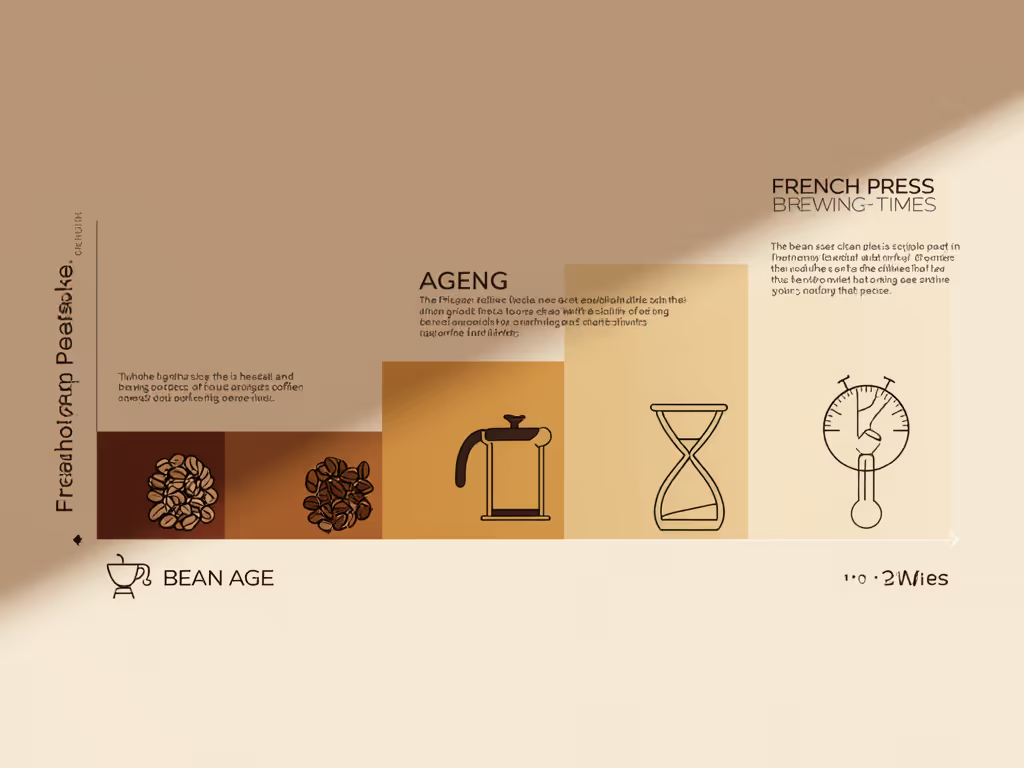
Answer: Bean age compounds mineral sensitivity. Hard tap water (>150 ppm total hardness) accelerates extraction in aged beans, pushing you into bitter territory fast. For fresh and mid-age beans, hardness is less critical because gas off-gassing dominates the first 2 minutes anyway.
Practical rule:
If you don't know your water hardness, test with bottled water first. It's your control. Then brew an identical ratio, grind, and time with your tap water. If the tap version tastes noticeably hotter (more bitter/sharp), suspect hardness and filter accordingly. For step-by-step mineral targets and adjustments, see our water mineral balance guide.
Answer: Slightly, but the effect is modest if you hold ratio and grind constant.
A 3-cup press (17 grams to 275 milliliters)[1] and an 8-cup press (54 grams to 860 milliliters)[1] behave almost identically when brew parameters match (provided the press thermal mass is adequate). Thin glass loses heat fast; insulated or metal carafes hold temperature better, reducing brew-time drift. See our heat retention test for model-by-model temperature drop data.
For aged beans in a small press: Preheat the carafe with hot water, discard it, then brew immediately. Cold glass bleeds ~5-8°F per minute in the first 90 seconds. That's enough to derail aged-bean extraction timing.
For fresh beans in a large press: The brew window opens wider due to higher bean degassing, so you have more forgiveness across sizes.
Answer: Visual and tactile cues work, but are imprecise. Test, then trust.
Better method: Ask the seller or roaster. Most specialty roasters list roast date. If not available, assume 3-4 weeks old as a safe middle-ground dial-in and adjust from there.
Answer: None, in theory. In practice, aged beans leave more sediment and oils that cling to the metal filter.
The reason: older beans have drier cell walls. They release more fines (particle dust <0.1 mm) during grinding and brewing. Fines slip through the metal mesh and settle as sludge, especially problematic if you stir frequently (which aged-bean protocols sometimes require).[1]
Mitigation:
Cleanup time remains ~45-60 seconds either way if you rinse in-situ (carafe at sink, water running, quick scrub of mesh). For disassembly tips and de-greasing methods, see our French press cleaning guide.
Answer: Yes, and it's a practical workaround if your household buys inconsistently.
Blend formula: 60% aged (22+ days) + 40% fresh (12-14 days) = effective age profile of ~18 days. Grind and brew as you would beans at day 14-16 post-roast.[2][3]
Break down by weight, not volume. If brewing 30 grams, use 18 grams aged + 12 grams fresh. The ratio dampens CO2 aggression from fresh beans and slows over-extraction from aged beans, landing you closer to a repeatable middle ground.
This doesn't beat a single, consistent age, but it reduces the number of dial-in profiles you need to maintain.
Bean age is primary, but press materials matter. Glass loses heat 2.5x faster than stainless steel. Ceramic falls between.[1]
If brewing stale coffee in a thin glass carafe, add 30 seconds to your brew time to compensate for temperature drop. If using insulated stainless, reduce by 15-20 seconds. This is why a reliable press (one with stable thermal mass and a tight lid) becomes essential when dialing across bean ages. You can't compensate for poor thermal design with ratios alone.
Bean age isn't a footnote; it's a primary variable that reshapes French press coffee reproducibility. The data is clear:
The path forward is transparent and measured. Acquire a bean age label (ask your roaster). Buy a scale, a timer, and a burr grinder. Lock in a single age profile for two weeks, brew daily if you drink daily. Log grind size, water temp, bloom time, total brew time, and cup assessment (sour, balanced, bitter). After 10 brews, you'll own the dial-in for that age. When you move to a new batch, shift one variable at a time: grind coarser, extend bloom, lower temp. Test, then trust. If it can't repeat, it can't be your daily driver.